Labour Market Assessment for Myanmar Youth in Thailand: Strengthening Skills, Protection, and Economic Inclusion
Finn Church Aid (FCA) Thailand has released a new Comprehensive Labour Market Assessment on Myanmar youth migrants in Thailand, shedding light on how young Myanmar are sustaining key sectors of the Thai economy while facing persistent gaps in protection, skills development and economic inclusion.
This assessment provides an evidence-based analysis of the labour market situation of Myanmar youth migrating to Thailand, with the aim of informing policy development, programmedesign, and advocacy to promote safe migration, decent work, and social inclusion. The study surveyed 400 Myanmar youth migrants and interviewed employers, Thai authorities, civil society organizations, Technical and Vocational Education and Training (TVET) providers, financial institutions, and recruitment agencies, across Bangkok, Samut Sakhon, Pathum Thani, Nonthaburi, Chiang Mai, and Tak provinces.
Findings illustrate that Thailand depends on Myanmar youth to keep key industries running, yet too many of these young workers remain invisible in data, policy and services. Migration from Myanmar to Thailand has accelerated sharply since 2020, driven by political instability, economic crisis and the enforcement of conscription, alongside ongoing demand for labour in Thai manufacturing, food processing, construction, logistics and services.
Over 70 percent of surveyed youth migrated from Myanmar to Thailand between 2020 and 2024, many through informal channels that expose them to higher legal and financial risks as legal recruitment pathways are complex. Gaps in enforcement of labour laws and administrative hurdles leave newly arrived youth at high risk of arrest, exploitation, and exclusion from services.
Despite relatively high education levels—around two-thirds of surveyed youth are working in jobs that do not match their skills or field of study. Limited access to Thai language courses, market-relevant technical training and recognized qualifications contributes to this “skills mismatch”. At the same time, more than 60 percent of surveyed youth expressed strong motivation to upskill, yet only a few were aware of existing training opportunities. With the right investments in skills, documentation and protection, this generation can contribute even more to both Thailand’s economy and Myanmar’s future.
Civil society and community-based training centres—including Thai and Myanmar non-governmental organizations working along the border—play a vital role in filling service gaps, providing language classes, vocational skills and legal counselling. However, the ecosystem is fragmented, under-funded and only lightly connected to employers and government programmes.
The report sets out concrete recommendations for government, development partners, private sector and civil society, including: strengthening cross-ministerial coordination and data systems to support safe migration, decent work, and social inclusion for Myanmar youth; expanding flexible, accredited skills training that is open to migrant youth; improving enforcement of labour protections; promoting migrant-friendly financial services; and creating structured partnerships between employers, TVET providers and NGOs for on-the-job training and skills recognition.
FCA and its partners invite policymakers, employers and development actors to use the findings to design more inclusive policies and programmes that ensure Myanmar youth migrants can move and work safely, learn, earn and participate fully in the societies they help sustain.
Background
The Labour Market Assessment is commissioned under Finn Church Aid’s Youth on the Move: A Regional Approach to Resilience project, a collaborative project of FCA Nepal, FCA Myanmar, and FCA Thailand, with support from the Ministry for Foreign Affairs of Finland. The project integrates the right to quality education and right to livelihood strategies by focusing on empowering youth in vulnerable situations to achieve economic self-reliance while incorporating the right to peace by fostering environments and dialogues that promote youth leadership, collective support and social cohesion, addressing the root causes and effects of the migration crisis. In Thailand, FCA collaborates closely with the Spirit in Education Movement (SEM) in implementing activities to empower Myanmar youth with knowledge, skills, and networks to navigate migration safely, build resilience, prevent exploitation, and foster social cohesion.
Report downloads
Labour Market Assessment Full Report (English)
Labour Market Assessment Summary Report (English)
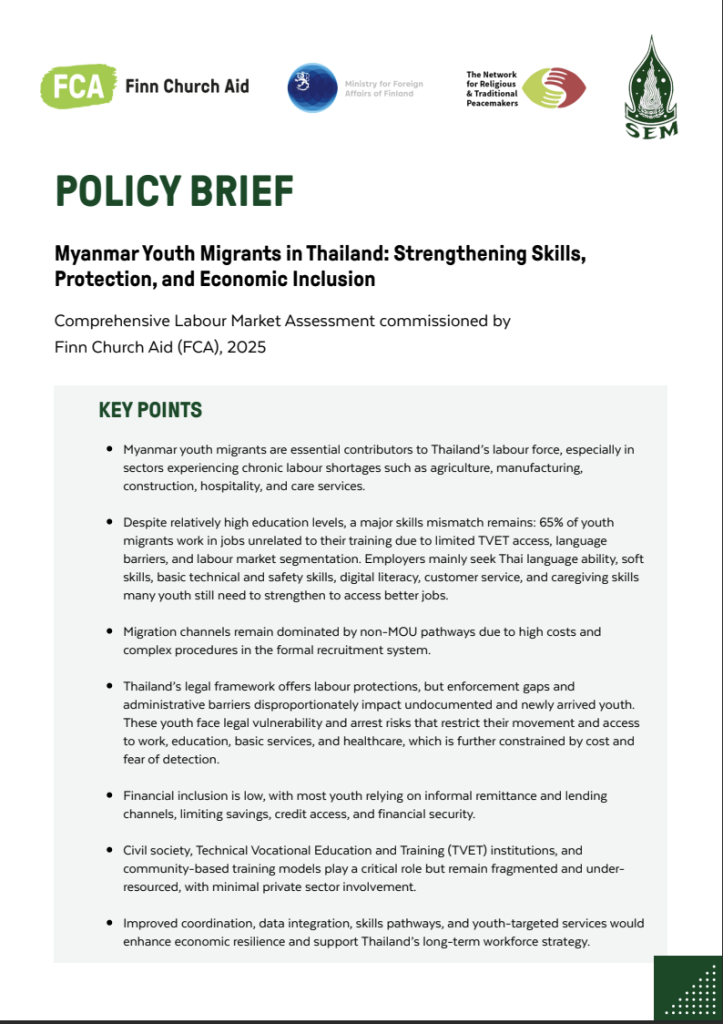
Labour Market Assessment Policy Brief (English)